
Every four years, the excitement among soccer enthusiasts peaks as the FIFA World Cup approaches, the pinnacle event in international soccer. The process that leads up to the games includes extensive efforts by artists and scientists who work tirelessly on designing, testing, and refining the official game ball. Recently, details about the ball planned for the 2026 World Cup leaked, revealing a design that intriguingly blends mathematics, physics, and aesthetics.
Dubbed the Trionda, which translates to “triwave” in Spanish, the ball is a tribute to the three countries hosting the event: the USA, Mexico, and Canada. This is the first time the World Cup will be hosted by multiple nations. Remarkably, the Trionda is constructed from just four panels, the fewest of any FIFA World Cup ball to date, a stark contrast to the 20-panel design of the 2022 Al Rhila ball.
The challenge in designing a soccer ball has always centered around one fundamental question: how to create a spherical object from flat materials. To solve this, World Cup balls have traditionally drawn from the geometric principles of platonic solids, which are the simplest forms of three-dimensional shapes made from identical polygons that meet symmetrically at each vertex.
Supporting Science Journalism
If you appreciate this content, please consider supporting our award-winning journalism by subscribing. Your subscription helps sustain the future of journalism that brings you closer to the innovations and explorations that shape our world.
Amanda Montañez
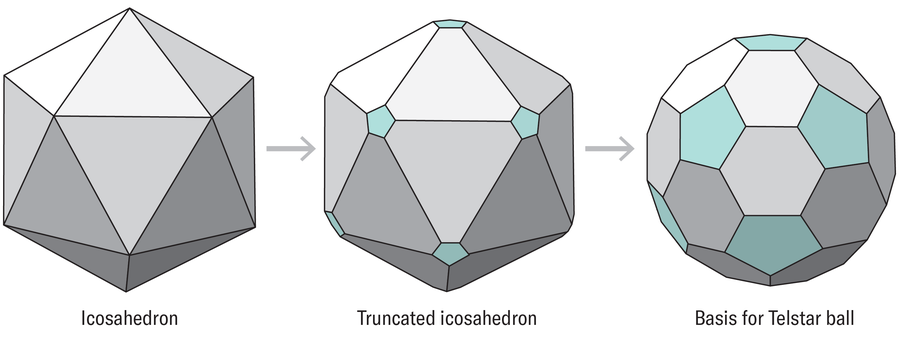
One promising shape is the icosahedron, which consists of 20 triangular faces and has a relatively spherical form, although still somewhat pointy. By truncating, or cutting off, the points of an icosahedron, each triangle transforms into a hexagon, and each vertex into a pentagon.
Amanda Montañez
This is the shape of the classic soccer ball, originally called the Telstar ball and used in the official FIFA World Cup match in 1970. The stark black-and-white color scheme was meant to increase visibility on black-and-white TVs, which were still prevalent at the time.
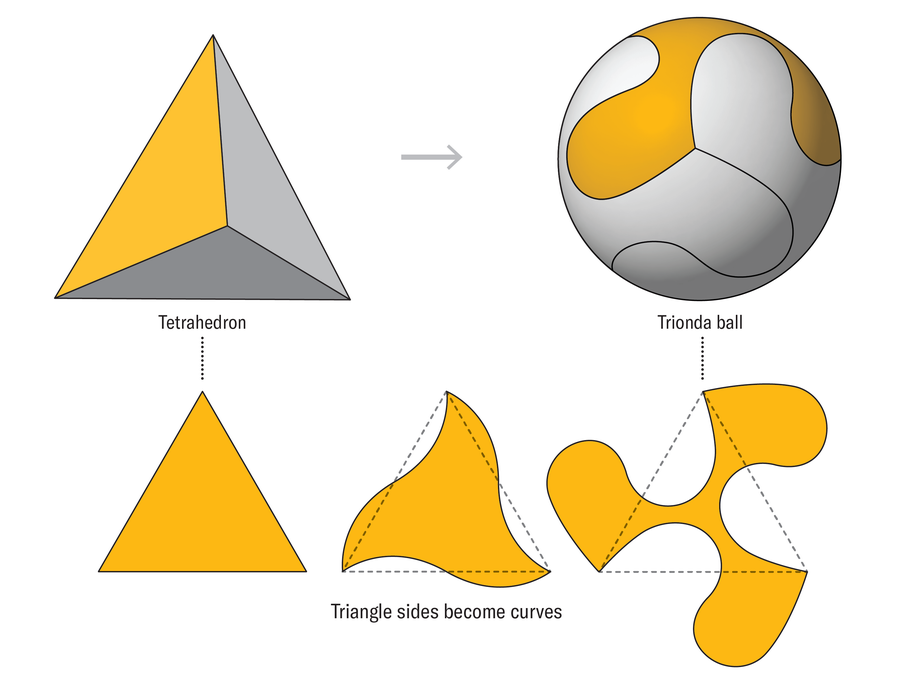
The Trionda ball is also based on a platonic solid—the tetrahedron—which at first seems the least ball-like of all the famous shapes. A tetrahedron is made of four triangles, three of which meet at every point. The trick in the Trionda design is in the shape of the panels. Though they have three points like a typical triangle, the panels’ edges are curves that fit together to give the ball a more rounded exterior.
Amanda Montañez
This method of making a pointy platonic solid rounder by curving the edges of the faces may be familiar to soccer fans; in fact, the design of the Trionda ball strongly evokes the Brazuca⁠, a six-paneled ball based on a cube that starred in the 2014 World Cup.

Cameron Aldridge combines a scientific mind with a knack for storytelling. Passionate about discoveries and breakthroughs, Cameron unravels complex scientific advancements in a way that’s both informative and entertaining.