
It’s likely that the Gaia observatory has had the most significant impact on astronomy in this century, yet it remains relatively unheard of by the general public. Just recently, the Hayden Planetarium at the American Museum of Natural History in New York introduced a new space show named Encounters in the Milky Way, starring this often unnoticed spacecraft. Despite its pivotal role, the space mission crucial to the show is less known than Pedro Pascal’s narration of it.
Named Gaia, this observatory’s absence would be profoundly felt, and indeed, it now is.
Launched by the European Space Agency (ESA) in 2013, Gaia’s mission ended this past March when it depleted its remaining fuel to move into a disposal orbit around the sun. Stationed in a peaceful part of deep space over a million kilometers from Earth, Gaia’s primary goal was seemingly straightforward: to refine our understanding of our position in space across multiple scales. Utilizing dual telescopes and a trio of scientific instruments, including a billion-pixel camera, Gaia meticulously cataloged the distances, positions, movements, and other characteristics of approximately two billion celestial bodies, mainly stars within our galaxy. Over its lifetime, it amassed around three trillion observations, producing the most detailed and precise three-dimensional map of the Milky Way ever.
Supporting Scientific Journalism
If you appreciate this article, please consider supporting our award-winning journalism by subscribing. Your subscription helps secure the future of influential stories that shape our understanding of the world.
“Gaia was our premier galactic mapmaker, and I often describe Encounters in the Milky Way as my personal tribute to it,” says Jackie Faherty, a senior research scientist at AMNH, who developed the new space show and frequently uses Gaia data. “Determining the positions and distances of stars, and how they move, can teach us a great deal. The map Gaia created is as iconic and practical as any terrestrial map we use in schools or on Google. It’s a gateway to discovering so much about our galaxy.”
From Gaia’s comprehensive stellar map, over 13,000 peer-reviewed studies have emerged, delving into the fundamental structure and ancient history of the Milky Way. With Gaia’s data, scientists have better estimated the amount of dark matter in our galaxy and traced its growth over billions of years through streams of stars left from ancient mergers with smaller galaxies.
“Stars retain records of their origins in their ages, movements, and chemical makeup, all of which Gaia measured,” explains Amina Helmi, an astronomer at the Kapteyn Astronomical Institute in the Netherlands. Her team used this data to uncover evidence of a significant galactic merger that occurred about 10 billion years ago, shaping our Milky Way into what we recognize today.
“With all this information, it was like lifting a veil,” Helmi adds. “We could engage in what’s sometimes called ‘galactic archaeology,’ piecing together our galaxy’s past to understand how and when this merger with another galaxy occurred. Gaia lets us peer billions of years into the past of the Milky Way—before our solar system even existed—to uncover our cosmic heritage, which is truly astounding.”
Astronomers have also used Gaia to detect a recent and ongoing merger that appears to have caused a warp in the Milky Way’s disk, adding a new layer to our classic view of the galaxy. On a smaller scale, Gaia has refined the orbits of over 150,000 asteroids, monitoring hundreds to determine if they have moons. It has also provided clues to thousands of exoplanets and even a few black holes circling other stars. On larger scales, it has aided in estimating the expansion rate of the universe and has subtly revealed how the Milky Way’s core tugs on our solar system across tens of thousands of light-years.
Based on Gaia’s data, this artist’s impression shows our Milky Way galaxy from its side, highlighting an apparent warp in the galaxy’s starry disk.
ESA/Gaia/DPAC, Stefan Payne-Wardenaar (CC BY-SA 3.0 IGO)
Gaia’s comprehensive cosmic survey now serves as a foundational element for many of the latest ground- and space-based telescopes, which depend on its detailed celestial map for guidance and calibration. This includes NASA’s James Webb Space Telescope, ESA’s Euclid mission, the Vera C. Rubin Observatory in the U.S., and the upcoming Extremely Large Telescope in Europe, making Gaia a guiding star for some of the most advanced astronomical observatories worldwide.
Remarkably, the best may still be ahead. Over two-thirds of Gaia’s data treasure remains unrevealed, undergoing a meticulous process for release. About half of its total data is expected next year, with the complete dataset anticipated no sooner than 2030.
Originally, Gaia was not designed to capture images fit for vibrant posters or desktop backgrounds. Consequently, it has been “criminally under-recognized outside of astronomy circles,” according to Mark McCaughrean, an astronomer and former senior adviser to ESA. “And because Gaia provided crucial but mundane information like precise stellar distances, it suffers from being both ubiquitous and obscure. Many people use its data, considering it just another entry in a catalog.”
Leiden University’s Anthony Brown, who heads the mission’s data processing and analysis group, sums it up succinctly: “For astronomers, Gaia has become as essential as the air we breathe,” he states.
At the core of Gaia’s mapping prowess is a method known as astrometry, which involves measuring the positions and movements of celestial bodies across the sky. When combined with parallax—the apparent shift in an object’s position observed from two different points—this technique enables astronomers to calculate distances too. You can observe parallax yourself by extending your thumb and alternately closing one eye and then the other; your thumb will seem to jump from side to side. The closer the object, the larger this jump will appear, and the greater the distance between your viewpoints, the smaller the detectable shift. Human eyes have about six centimeters between them; Gaia’s was a staggering 300 million kilometers, determined by Earth’s orbit around the sun.
Gaia’s predecessor, ESA’s Hipparcos mission, used this vast baseline to map the heavens from 1989 until it exhausted its fuel in 1993. However, technological limitations at the time restricted Hipparcos’s astrometric precision to about one milliarcsecond, with high-quality measurements only for roughly 100,000 objects within about 200 parsecs (650 light years) of the solar system. (To put this in perspective, a single arc second is a tiny angular slice of the sky, highlighting just how impressive Hipparcos’s milliarcsecond accuracy was. For comparison, the moon spans about 1,800 arc seconds as seen from Earth.)
While Hipparcos set a high bar, Gaia shattered its records—though not without its own challenges, such as precision-compromising stray light that leaked around the spacecraft’s sun shield and through a hole caused by a stray micrometeoroid. Ultimately, Brown notes, Gaia achieved a precision about 100 times greater, reaching about 10 microarcseconds, and its view included 100 times more volume and ten times more targets within the Milky Way.
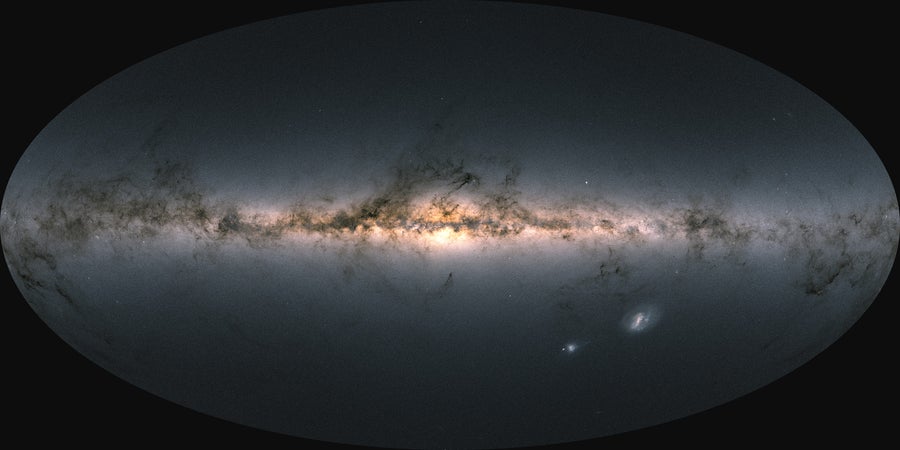
This map of the entire sky is based on Gaia’s data for the positions, brightness and color of more than 1.8 billion stars.
ESA/Gaia/DPAC; CC BY-SA 3.0 IGO; Acknowledgement: A. Moitinho (CC BY-SA 3.0 IGO)
The scale of Gaia’s measurements seems almost surreal, according to Michael Perryman, a former ESA researcher who served as project scientist for both Hipparcos and Gaia, playing a critical role in their development. He compares Hipparcos’s accuracy to discerning a second’s worth of growth of a human hair from one meter away. Gaia’s precision, he notes, is akin to measuring the width of a hydrogen atom from the same distance.
The sheer volume of data collected by Gaia is equally staggering. Perryman recalls that when the Hipparcos team printed their complete catalog, it filled five thick volumes—nearly a full bookshelf. To print the Gaia catalog with the same density of information per page, he estimates, would require about 10 kilometers of shelf space.
“It’s almost beyond comprehension; these are scales we’re just not equipped to visualize, so even the analogies are hard to grasp,” he remarks.
Perhaps the most impressive feat of Gaia’s precision is its determination of the solar system’s acceleration relative to a vast backdrop of quasars. Quas
Similar Posts
- Mysterious Star Defies Science: Born Against Impossible Odds
- Milky Way vs. Andromeda: Collision Not as Certain as Once Thought
- NASA’s Voyager Probes Uncover Mysteries Beyond the Solar System!
- 2025 Cosmic Mystery: Is Our Universe Segment Unique?
- China Unveils Secret Mission to Mysterious Quasi-Moon: Tianwen 2 Explained

Cameron Aldridge combines a scientific mind with a knack for storytelling. Passionate about discoveries and breakthroughs, Cameron unravels complex scientific advancements in a way that’s both informative and entertaining.