
This article was created in collaboration with the Pulitzer Center’s Ocean Reporting Network.
As three snowmobiles roared across the Arctic sea ice under a haloed sun, a light snow swept over the vast icy terrain. It was a chilly –26 degrees Celsius as we departed from Cambridge Bay, an Inuit hamlet nestled within a sprawling cluster of barren islands and ice-filled waterways in far northern Canada. This temperature, though frigid, was actually six degrees Celsius warmer than usual. This winter marked the mildest in 75 years, and the Arctic Ocean’s ice was at its lowest recorded winter extent. Scientists now believe that in as little as 15 years, the Arctic’s summer ice could vanish entirely for the first time in thousands of years, potentially accelerating global warming significantly. Amid this bleak outlook, a UK-based company named Real Ice, leading our small convoy, is engaging in what some call a highly ambitious, if not reckless, plan to reverse these effects.
Seven kilometers from the village, Cían Sherwin, co-founder of Real Ice and sporting a red beanie and a rugged goatee, dismounted his snowmobile and began to drill into the ice using a lengthy electric auger. As he breached the ice, over a meter below, a mixture of icy water and shavings burst forth. Inuit guide David Kavanna expanded the hole using a spear-like ice saw and set up a wooden enclosure around it. Sherwin then lowered an aluminum pump, resembling an oversized coffee dispenser attached to a flexible hose, into the water. He connected it to a battery pack and within moments, water began to cascade out of the hose, spilling onto the ice in shades of surreal blue. “As it freezes,” Sherwin explained, “the water acts almost like lava. It starts forming ice almost immediately.”
Supporting Science Journalism
If you find this article engaging, please consider supporting our award-winning journalism by subscribing. Your subscription helps us continue bringing important stories about groundbreaking discoveries and ideas that shape our future.
The ice cap typically extends its reach during the winter months, forming thin, wide sheets that retract in the summer when the sun is omnipresent. This ice serves as a massive reflective barrier, bouncing back up to 90 percent of the sun’s energy. In contrast, the ocean waters absorb the same amount of sunlight, which exacerbates warming. Over the past four decades, the core perennial ice has diminished by about 40 percent, propelling a self-intensifying cycle: melting ice exposes more water, which absorbs more heat, leading to further ice loss. If this cycle continues, global temperatures could climb an additional 0.19 degrees Celsius by 2050.
Real Ice’s strategy involves artificially thickening the ice so it can withstand the summer heat longer, thus cooling the planet. Sherwin envisions a future where they could refreeze around a million square kilometers of both seasonal and permanent ice—an area roughly the size of Texas and New Mexico combined. Achieving this would require deploying about half a million robotic ice-making units, according to the company’s estimates.
Dolly Holmes
This geoengineering effort on such a grand scale could serve as a temporary solution to global warming while the world shifts away from fossil fuels. Although many experts are skeptical about its feasibility, those at Real Ice argue that we must attempt every available option; research suggests that even drastic cuts in fossil fuel consumption might not be sufficient to preserve the summer sea ice. “It’s unfortunate that it has come to this, but we have to take action,” Sherwin remarked while we surveyed the icy expanse. “Simply reducing emissions isn’t enough anymore.”
Cambridge Bay, originally named by British explorers after a 19th-century Duke of Cambridge, is home to around 1,800 mostly Inuit residents and is located opposite the Canadian mainland on Victoria Island, one of the largest islands in the world. Upon my arrival at the small one-room airport on a twin-engine turboprop, I was welcomed by a stuffed musk ox and a display detailing the 1845 British naval expedition led by John Franklin. Cambridge Bay sits along the Northwest Passage, an icy maritime route between Europe and Asia that has captivated explorers for centuries. Franklin’s expedition, aimed at charting this passage, ended in disaster when his ships, Erebus and Terror, became trapped in the heavy sea ice that moves towards Cambridge Bay each winter, forming ridges up to 10 meters high. All 129 crew members eventually succumbed to the cold, starvation, or disease. Nowadays, cruise ships navigate the passage annually, often visiting the gravesites of Franklin expedition members.
The Inuit refer to Cambridge Bay as Ikaluktutiak, or “good fishing place.” Their nomadic ancestors have frequented this area for millennia to fish for Arctic char, a silvery-orange fish related to the brook trout. Permanent settlements began to form in the 1940s and 1950s when the U.S. military employed Inuit labor to construct a navigation tower and a radar station to monitor potential Soviet bomber incursions over the North Pole during the Cold War. This period also sparked interest in manipulating the Arctic environment. The Soviet Union considered methods such as dispersing coal dust or setting off explosions to break up the sea ice and even detonated three nuclear devices in an attempt to create an Arctic canal. In the U.S., physicist Edward Teller’s Project Plowshare nearly received approval to create a harbor in Alaska using nuclear bombs.
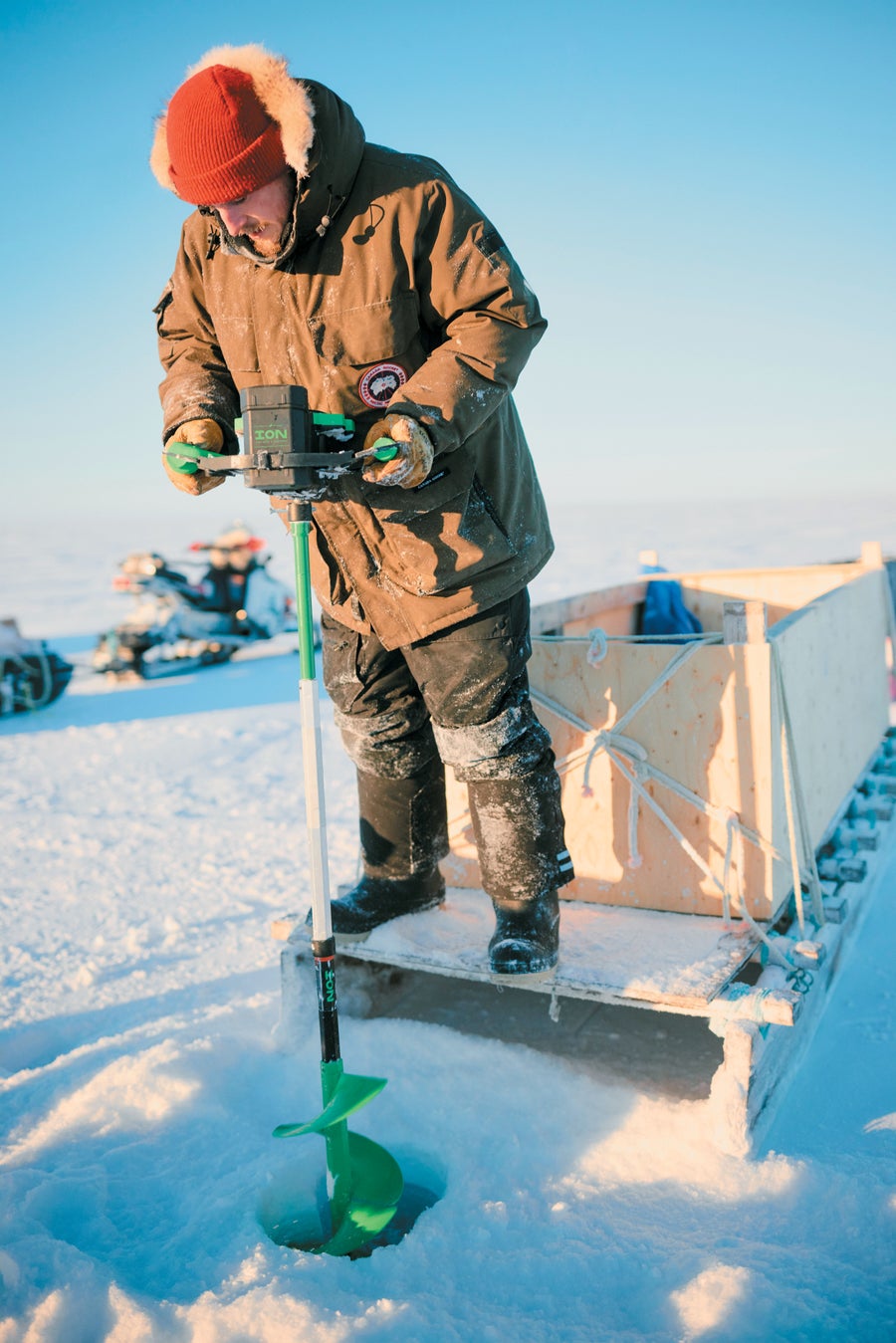
Real Ice co-founder Cían Sherwin drills through the ice sheet, a meter thick, into seawater below.
Taylor Roades
Modern geoengineering efforts are aimed at cooling the Earth to mitigate climate change. Some scientists and entrepreneurs have focused on distributing sulfate particles in the stratosphere to block sunlight, potentially reducing heating but also potentially disrupting global weather patterns like the South Asian monsoon. Mexico recently implemented a ban on this form of solar geoengineering after a Silicon Valley startup, Make Sunsets, released two balloons filled with sulfur dioxide within its borders. In California, the city of Alameda stopped an experiment that involved spraying sea salt particles into the air to make clouds more reflective. Field trials aimed at the Arctic, the Antarctic, and the “third pole”—the massive glaciers of the Himalayas—have generated less controversy, possibly because any unintended consequences would be limited mostly to those remote areas. In Iceland and India, the Silicon Valley-based nonprofit Bright Ice Initiative has dispersed tiny glass beads on glaciers to try to reflect more sunlight and slow melting. Chinese agencies have used rockets, planes, drones, and chimneys to release chemical smoke into clouds, inducing snowfall over glaciers on the Tibetan Plateau. Researchers in Scandinavia are developing massive curtains that could be anchored to the seafloor to block warm ocean currents from melting the undersides of Antarctic ice shelves. Implementing these measures on a scale large enough to impact the climate would cost billions of dollars.
The concept of artificially thickening ice originated from extraterrestrial studies. At a 2012 conference, a contentious forum on global warming dampened the hopes of Arizona State University astrophysicist Steve Desch, who studies icy celestial bodies like Pluto’s moon Charon, for swift climate action. Desch wondered if we could buy time by generating ice in the Arctic. The challenge is that sea ice forms from the bottom up. Once the initial layer solidifies, it insulates the seawater from the frigid air, which can be 50 degrees Celsius colder. The thicker the ice becomes, the slower it grows. In 2016, Desch published a paper suggesting that wind-powered pumps could accelerate sea ice growth by pulling water from beneath and spreading it across the surface.
Inspired by a documentary on the Arctic, students at Bangor University in Wales built a prototype “re-icing machine,” a clumsy assembly of hoses that spun like a lawn sprinkler. One of those students was Sherwin. Encouraged by Desch’s paper, he and London entrepreneur Simon Woods founded Real Ice in 2022 to explore whether the process of thickening sea ice could be scaled up. They later enlisted Desch and several sea-ice scientists as advisors. The company tested its first water-to-ice conversion in Nome, Alaska, in January 2023, replacing the sprinkler with a commercial pump. The following year, they relocated to the Canadian High Arctic Research Station in Cambridge Bay to continue their experiments. “It’s not exactly like natural ice formation, but it’s as close as we can get,” Desch says.
After the team drilled the initial hole that February morning and started the pump, we rode our snowmobiles to a location pinpointed by GPS, several hundred meters away. Once again, the group drilled and inserted a pump, and water began gushing out. We installed four pumps at four different locations that day. As the water pooled, it spread outward, soaking into the pockmarked snow, which was up to 25 centimeters (10 inches) thick and crusty like hardened white frosting. Within hours, the pool would solidify into electric-blue slush, resembling a gas station Slurpee.

Cameron Aldridge combines a scientific mind with a knack for storytelling. Passionate about discoveries and breakthroughs, Cameron unravels complex scientific advancements in a way that’s both informative and entertaining.