
Recent news and social media outlets have issued alerts about a potentially hazardous invasive ant species. While it may seem like a fresh menace has emerged, the Asian needle ant (Brachyponera chinensis) has been around for a while, quietly blending into its surroundings.
The spotlight turned to this ant following a statement from Dan Suiter, an entomologist at the University of Georgia (UGA), about its excruciating sting and its potential to trigger severe allergic reactions, including anaphylaxis. According to Suiter, there hasn’t been a change in the ant’s proliferation rate. As an entomologist with the UGA Cooperative Extension, he has responded to several incidents of stings requiring medical attention. With the onset of summer, the ant is quite active, leading to increased human encounters especially in wooded or garden areas, prompting heightened public awareness.
“By this time last year, I received three reports of stings from the Asian needle ant that led to anaphylaxis,” mentioned Suiter. He points out that the ant’s unremarkable, small, black appearance makes it easily overlooked. “You wouldn’t think such a tiny insect could cause significant harm if it stung you.”
Supporting Science Journalism
If you appreciate this content, consider supporting our award-winning journalism by subscribing. Your subscription helps sustain the future of detailed articles about groundbreaking discoveries and ideas that shape our world.
Originally from Japan, Korea, and China, the Asian needle ant likely made its way to the U.S. around or before the 1930s, probably aboard ships transporting plants and livestock. Theresa Dellinger, a diagnostician at Virginia Tech’s Insect Identification Lab, notes that this was before the implications of such transport methods were well understood. While it’s difficult to pinpoint exactly where the ant has spread in the U.S., it is predominantly found in the Southeast and has been spotted as far north as Massachusetts, according to the iNaturalist app. Its presence is less common west of Missouri, likely due to its poor adaptation to dry conditions.
Research indicates that Asian needle ants displace native ant species when they colonize a new area, diminishing local ant diversity.
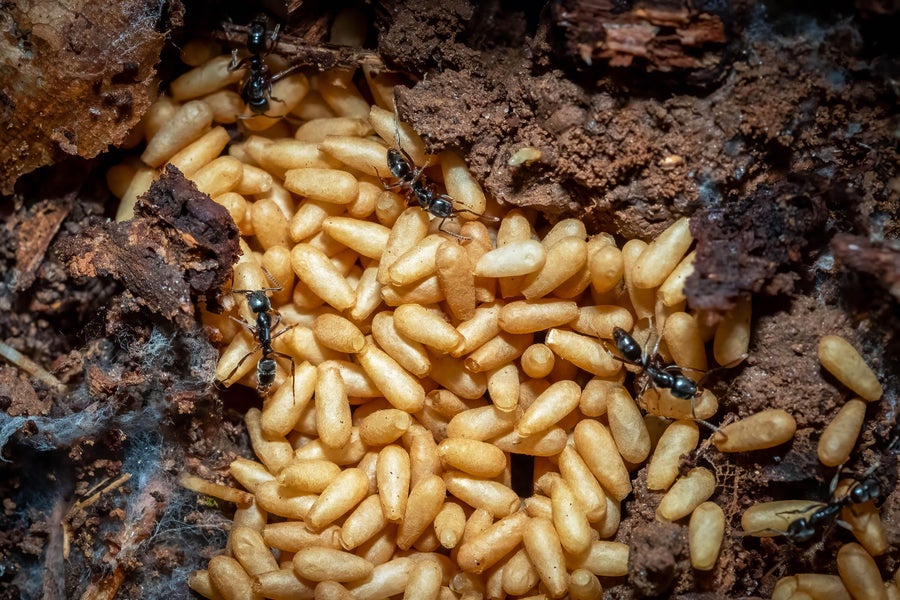
Asian Needle Ants (Brachyponera chinensis) with pupae.
Samuel Ray/Alamy Stock Photo
Unlike typical ants that use pheromone trails to guide their colony to food, Asian needle ants adopt a different strategy. When one finds food, it returns to the colony, fetches another worker, and physically leads them to the food source, explains Christopher Hayes, an entomologist at North Carolina State University.
These ants prefer moist environments for their nests, such as decaying logs or damp mulch, rather than constructing large visible mounds like fire ants. They are generally not aggressive but will sting to defend their nests, posing a risk to those gardening at home.
Their stings are initially more painful than those of fire ants and can remain bothersome for some time, akin to having fiberglass under the skin. The pain may also reoccur, as Hayes experienced when his two-year-old son was stung. The child was initially fine but awoke later in pain.
In their native habitat, the sting of the Asian needle ant carries about a 2 percent chance of causing anaphylaxis, a higher risk compared to fire ant bites, which have a 0.5 to 1.5 percent risk, according to Hayes.
If you encounter an Asian needle ant, it’s best to gently remove it by flicking or brushing it off, advise Hayes and Suiter. If stung, try to capture the ant for identification, though it may escape quickly. Should symptoms like hives, swollen lips or tongue, or breathing difficulties occur, seek immediate medical help as these are signs of anaphylaxis.
If you suspect Asian needle ants are on your property, capturing a clear photo or collecting a specimen with tweezers for identification by a local agricultural agent is advisable, says Suiter. Although there’s no centralized tracking of these ants’ spread, increased public awareness could encourage further scientific research. Identification becomes crucial for those with a history of severe reactions to insect stings, especially if they carry an Epipen for emergencies. “It’s vital for individuals at risk of anaphylaxis to recognize what this ant looks like,” Suiter emphasizes.
Similar Posts
- Discover Mongolia’s “Dragon Prince”: The Forgotten Ancestor of T. rex Unveiled!
- Los Angeles Wildfires: Impending Rain Threatens New Dangers!
- Severe Morning Sickness Linked to Specific Hormone, Promising New Treatments Ahead!
- Whales Could Live to 150, Shattering Age Expectations — Find Out How!
- Most U.S. Babies Lack Crucial Gut Microbes for Health – Find Out Why!

Cameron Aldridge combines a scientific mind with a knack for storytelling. Passionate about discoveries and breakthroughs, Cameron unravels complex scientific advancements in a way that’s both informative and entertaining.