
An hour’s journey by car along a rugged dirt track takes you deep into the Kibale National Park in Uganda, where a modest research station is tucked away amidst the chimpanzee-populated wilderness. The landscape here features ancient trees cloaked in tangled vines, while the equatorial horizon is set ablaze with sunsets that paint the savannas, lakes, and mist-covered mountains in hues of gold and red. Primatologists at this outpost start their days by examining a map detailing the prior day’s movements of the chimps, noting which trees are bearing fruit, and keeping an ear out for the distinctive “pant-hoots” of the apes that echo through the tree canopy at dawn. Depending on the day, the chimps might be nearby, or they might elude the researchers for hours as they navigate the 35-square-kilometer territory of the Ngogo chimpanzee community along a network of well-trodden paths.
During a morning in 2019, a team of researchers observed a young chimpanzee named Lindsay, about two years old, making an intriguing move: from atop her mother Beryl’s back, she reached out and covered Beryl’s sole functioning eye. Initially, this seemed to be a playful act. However, it soon became apparent that whenever Lindsay performed this gesture, Beryl would react by moving forward. Over time, this action evolved into a deliberate signal from Lindsay, signaling “let’s go.” Each time she touched her mother’s eye, Beryl proceeded to advance forward.
Chimpanzee Beryl and her infant, Lindsay, perform their “hand-on-eye” gesture.
Kevin C. Lee
Supporting Science Journalism
If you find this article engaging, consider supporting our award-winning journalism by subscribing. Your subscription helps us continue to deliver compelling stories about groundbreaking discoveries and ideas that shape our world.
What appeared to be a simple, impromptu gesture by Lindsay to capture her mother’s attention—by covering the eye with limited sight—turned into a consistent and meaningful signal over time, resembling a private joke or a secret handshake. Among the Ngogo chimpanzees, researchers are beginning to understand that such behaviors are not merely random but are integral to the apes’ culture and social interactions.
“This finding is significant from a scientific standpoint because there was no previous documentation of this gesture,” states Bas van Boekholt, a primatologist now with the University of Zurich, who spearheaded a recent study published in Animal Cognition to interpret the meaning behind this action. During his second field season at Ngogo in 2022, van Boekholt, while reviewing video footage recorded by his field assistant, first noted the hand-on-eye behavior exhibited by Lindsay. He points out that while unique gestures have been previously observed in captive nonhuman primates, convincing evidence of their occurrence in the wild has been lacking.
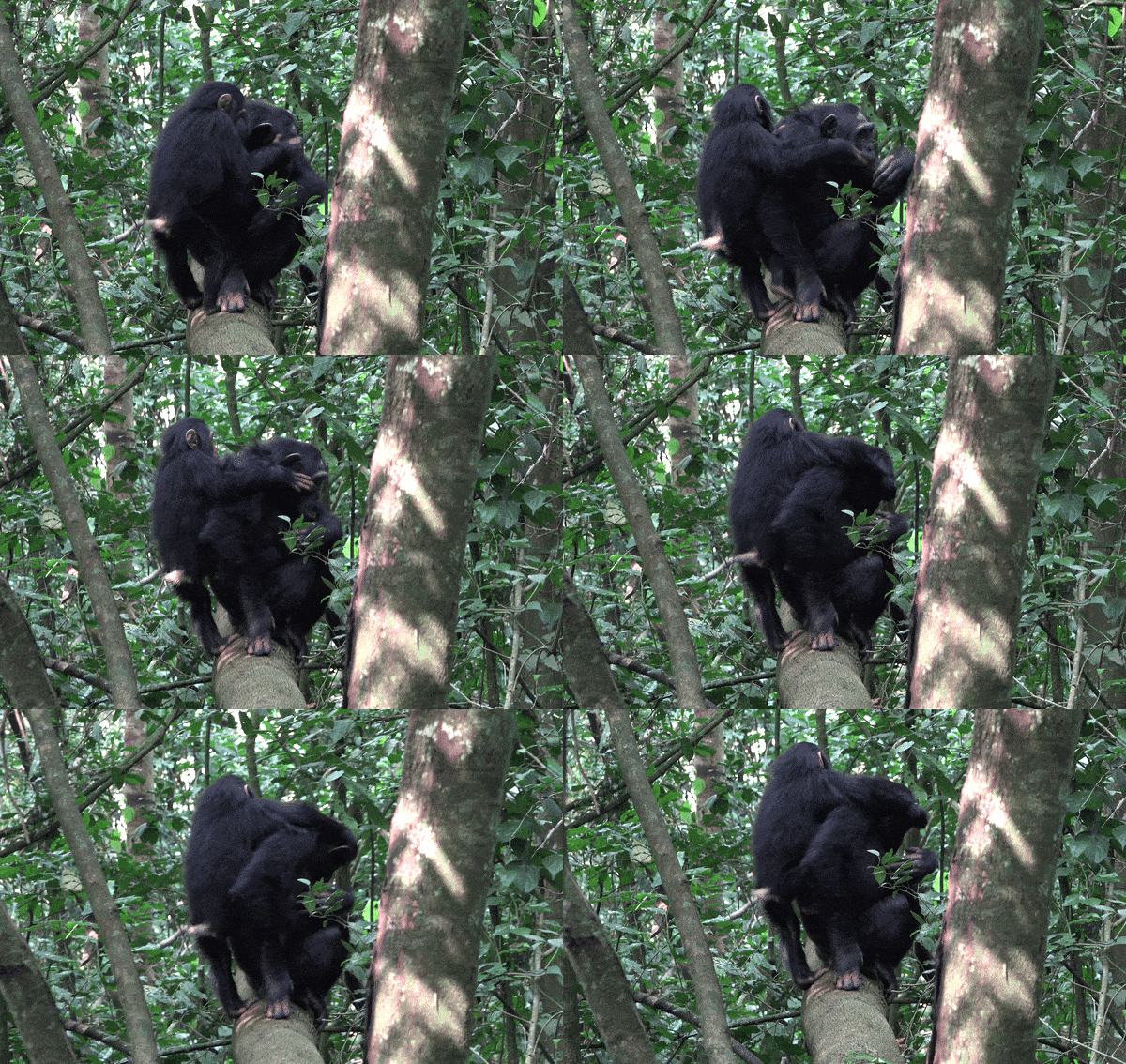
Lindsay covers Beryl’s eye.
Bas van Boekholt
Curious if others had observed the same gesture, van Boekholt contacted fellow researchers and field assistants. Isabelle Clark, a biological anthropologist at the University of Texas at Austin, remembered seeing the behavior as early as 2019. “This is groundbreaking because this gesture isn’t part of the usual chimp repertoire. It’s not listed in our chimp gesture dictionary,” she explains. “It’s a rare and fascinating example of how gestures might be learned rather than innate. I’m certain there are many subtle, unrecorded ones between closely bonded individuals, but this one was particularly noticeable and somewhat amusing.”
To delve deeper, researchers from various field seasons performed a collaborative quantitative analysis of 179 videos featuring Lindsay and Beryl, including 21 instances where Lindsay used the gesture. Young chimps are known to be playful while riding on their mother’s backs, so the researchers carefully examined Lindsay’s actions for signs of intentional behavior. Was it merely a random touch, or did it have a purpose? The analysis indicated it was the latter.
Van Boekholt’s team also reviewed over 1,020 video clips of 12 other mother-child pairs within the Ngogo community and discovered no other instances of the gesture—except for three isolated occurrences where other chimps performed it just once, without the same markers of intentionality found in Lindsay and Beryl’s interactions.
“Infants do play on their mothers’ backs and sometimes touch their mothers’ eyes, but it’s different; there’s no clear intent or consistent outcome,” van Boekholt notes. “Perhaps if we analyzed another 1,200 clips, we might find more cases, but at this point, we are confident this is a unique gesture.”

Chimpanzees Lindsay and her mother, Beryl, in 2019.
Kevin C. Lee
Clark, who specializes in the social behavior development of juvenile and adolescent chimpanzees, suggests that chimps demonstrate fundamental aspects of symbolic communication—similar to humans’ capacity to create endless symbols with various meanings. She believes that gestures like the one shared between Lindsay and Beryl could serve as the foundational elements of more human-like forms of communication.
“There are several theories about how gestures develop in primates, especially in great apes,” van Boekholt elaborates. “Tracking their development throughout a lifetime provides insights into the evolution of language and communication.”
The researchers acknowledge that if the hand-on-eye gesture is present in other chimpanzee communities, it likely conveys a different meaning there. Cat Hobaiter, a primatologist and field scientist not involved in the study, warns against drawing sweeping conclusions from observations of a single chimpanzee group. “It’s akin to trying to describe human civilization after only visiting a few cities like Paris, Shanghai, and Auckland,” she remarks. Just as customs and traditions vary widely across human cultures, so too can gestures among chimpanzees; a gesture that is reassuring in one group might mean something completely different, or nothing at all, in another.
For example, the well-known and extensively documented gesture of leaf clipping—where a chimpanzee tears a leaf with its teeth—differs in meaning across chimp communities. In some groups, the distinctive sound of leaf clipping serves as a mating call, while in others, it indicates frustration or an alpha male’s display of dominance.
Researchers studying ape communication have long debated whether gestures and signals like these are innate or learned through social context and experience. Many scientists now believe that while gestures may have biological roots, their meanings are shaped by social and environmental dynamics.


Cameron Aldridge combines a scientific mind with a knack for storytelling. Passionate about discoveries and breakthroughs, Cameron unravels complex scientific advancements in a way that’s both informative and entertaining.