
This essay is republished with permission from The Conversation, a digital platform focusing on current research.
In the Pilbara region of Western Australia, we have found Earth’s oldest known meteorite impact crater. Formed over 3.5 billion years ago, this crater surpasses the age of the next oldest by more than a billion years. Our findings are detailed in today’s issue of Nature Communications.
Interestingly, the crater was discovered right where we predicted, lending support to a theory regarding the formation of Earth’s earliest continents.
Supporting Science Journalism
If this article has caught your interest, consider backing our exceptional journalism by subscribing. Your subscription helps guarantee the continuation of meaningful reports on the concepts and discoveries that shape our present world.
Earth’s Primordial Stones
Earth’s oldest rocks, which emerged over 3 billion years ago, form the core of the majority of today’s continents. The exact processes of their formation, however, remain a topic of debate among geologists.
There is consensus, though, on the importance of these primeval continents in numerous chemical and biological processes that occurred on Earth.
Many geologists believe these ancient stones were born above hot plumes rising from Earth’s molten core, akin to the wax in a lava lamp. Others argue they were created by plate tectonic activities similar to those on modern Earth, involving the collision and subduction of rock masses.
Despite these differing viewpoints, both theories involve the dissipation of internal heat from our planet.
Our perspective, however, is different.
Years ago, we proposed that the energy needed to form continents in the Pilbara might have come from extraterrestrial sources, specifically through one or several meteorite impacts of substantial size.
These impacts would have ejected massive amounts of material and melted the surrounding rocks, while the mantle underneath would have produced thick volcanic blobs that eventually became continental crust.
Initially, our evidence was based on the chemical makeup of minuscule zircon crystals, the size of sand grains. To convince others in our field, though, we needed more robust evidence, something observable without a microscope.
Thus, in May 2021, we embarked on a two-week field trip to the Pilbara, joining forces with the Geological Survey of Western Australia (GSWA) to search for the crater. But where to start?
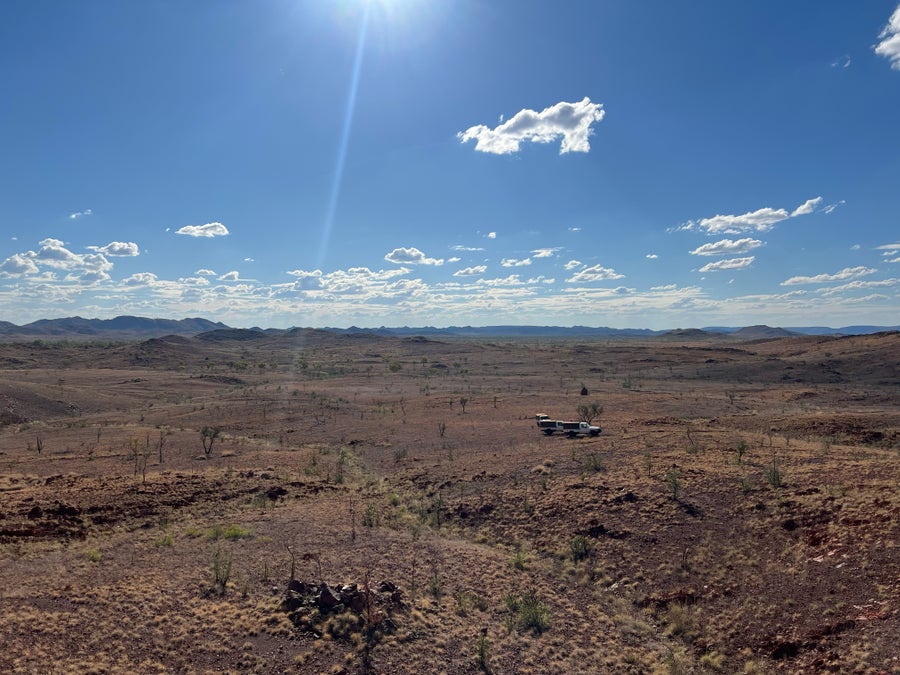
Searching for shatter cones in a typical Pilbara landscape with our reliable GSWA vehicles.
Chris Kirkland, Curtin University
A Fortuitous Start
We initially focused on an intriguing rock layer known as the Antarctic Creek Member, visible on the slopes of a dome about 20 kilometers in diameter. This layer, about 20 meters thick, primarily consists of sedimentary rocks nestled between deep layers of dark basaltic lava.
Included in this layer are spherules—tiny droplets formed from molten rock expelled during an impact. However, these droplets could have traveled from an impact anywhere on Earth, likely from a now-eroded crater.
Using GSWA maps and aerial photographs, we pinpointed a location in the heart of the Pilbara along a dusty track to start our search. We parked our off-road vehicles and split up to explore the outcrops, more hopeful than certain, planning to regroup in an hour to share findings and grab some food.
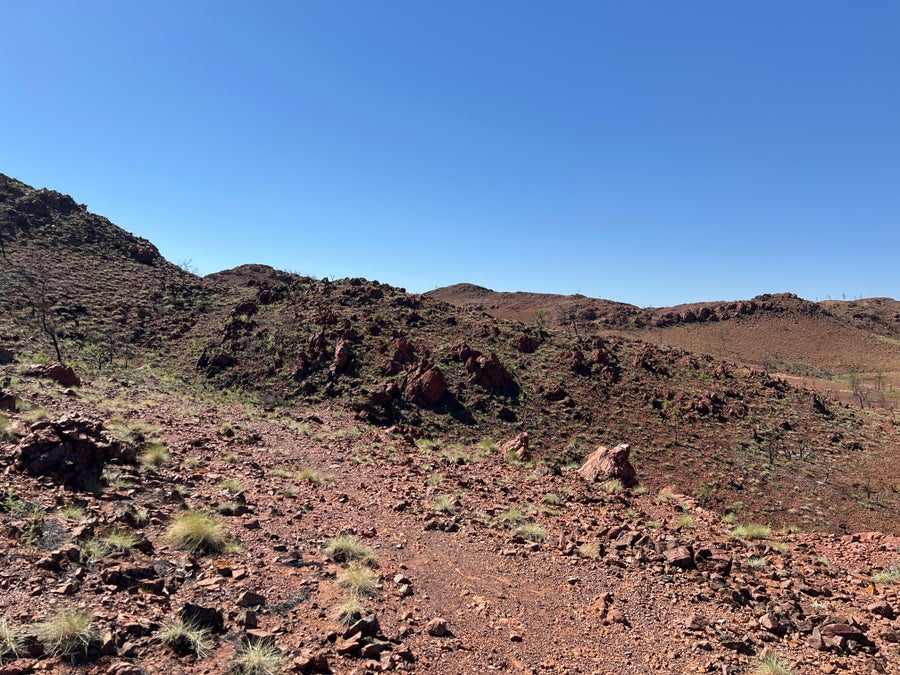
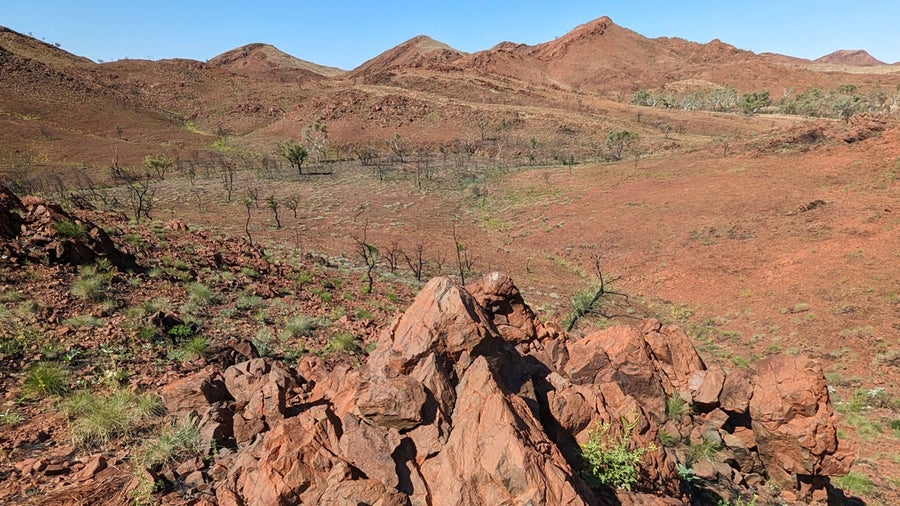
Large hut-like shatter cones in the rocks of the Antarctic Creek Member at the discovery site. The rocks on the hilltop farthest left are basalts that lay directly over the shatter cones.
Tim Johnson, Curtin University
Remarkably, when we reconvened at the vehicle, we all believed we had discovered the same phenomenon: shatter cones.
Shatter cones are stunning, delicately branching structures, somewhat resembling a badminton shuttlecock. They are the only clear shock feature visible with the naked eye and can only be formed by a meteorite impact.
Within just over an hour of starting our search, we had found exactly what we were looking for. We had literally stepped out of our 4WD vehicles and onto the floor of an immense, ancient impact crater.
After taking some photos and collecting a few samples, we had to move on to other locations, but we planned to come back as soon as possible. Most crucially, we needed to determine the age of the shatter cones. Had we indeed discovered the oldest known crater on Earth?
It turned out that we had.

Cameron Aldridge combines a scientific mind with a knack for storytelling. Passionate about discoveries and breakthroughs, Cameron unravels complex scientific advancements in a way that’s both informative and entertaining.