
Over the past five years, our understanding of the coronavirus has been constantly evolving. It has been a source of fear and a part of our everyday life, seen both as a deadly disease and as something as mild as the flu. It has presented itself through numerous variants, each making headlines before fading into obscurity.
Throughout these changes, one constant has been the deep-seated fatigue associated with COVID. It was exhausting to obsessively clean surfaces, only to find out the virus was primarily airborne. The rush to secure essentials like toilet paper, masks, and vaccines was draining. The fear of an unseen virus and the isolation from human contact weighed heavily on us. And the process of reintegrating into social settings, whether cautiously or recklessly, has been equally taxing.
No matter how we’ve individually reacted to the threat of the virus, its impact has loomed over us in unimaginable ways since we first encountered SARS-CoV-2. “I think we’re all exhausted, and we’re not actually admitting it,” states Alexandre White, a sociologist and historian of medicine at Johns Hopkins University. He argues that there is a crucial need for mourning and remembrance. “We’ve moved on from COVID too quickly, assuming there’s nothing left to discuss since we all endured it. But there’s still much to be discussed,” he adds.
Supporting Science Journalism
If you value this article, please consider supporting our award-winning journalism by subscribing. Your subscription helps secure the future of significant stories that explore the discoveries and ideas shaping our world.
Sharing our individual experiences of the past five years and listening to others could help mend the social fractures left by COVID in American society.
The Heavy Burden of the Pandemic
Shortly after the pandemic began, “quarantine fatigue” became a common term. As weeks turned into months, this evolved into “pandemic fatigue,” a term encapsulating a range of emotions from loneliness to boredom, anger, and fear.
Everyone’s experience varied based on several factors, with death being the most severe. In 2020, COVID was responsible for at least 385,000 deaths in the U.S., and over 463,000 in 2021, according to the Centers for Disease Control and Prevention. The continual loss of life, now totaling 1,225,281 as of early March, along with restricted funeral practices, has caused profound grief.
Those who haven’t lost someone to COVID have still experienced significant stress and fear, especially during the pandemic’s early stages. Medical professionals faced high burnout rates, and essential workers risked their lives daily. Children and working parents had to adapt to online learning and makeshift home offices. Social events and vacations were canceled, adding to the sense of loss.
In a recent survey, half of the U.S. adults felt that COVID had a minor impact on their lives, while a quarter felt it was major. Thirty percent mentioned they hadn’t fully recovered from its effects.
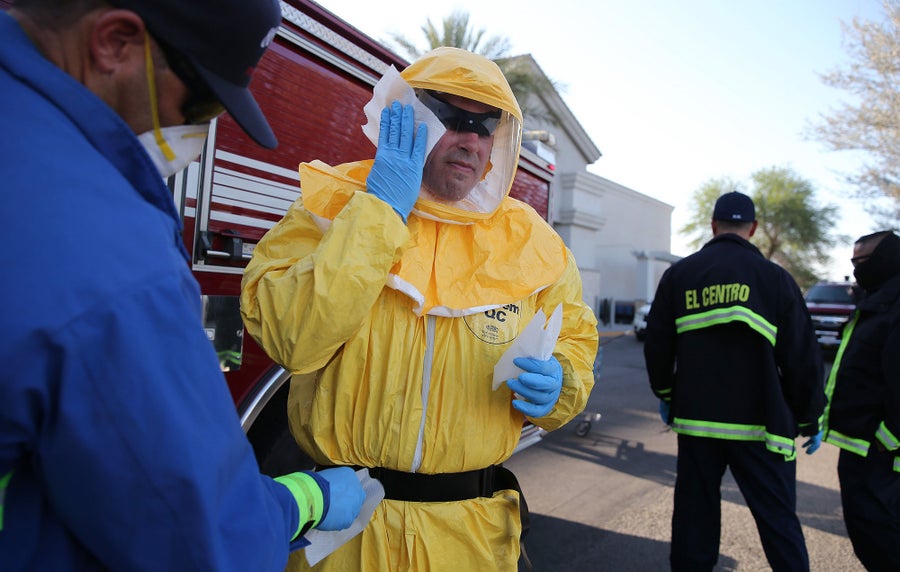
El Centro Fire Department firefighter/paramedic Chase Adame decontaminates his PPE (personal protective equipment) after treating a woman who fell in a parking lot in hard-hit Imperial County amid the COVID-19 pandemic on July 21, 2020, in El Centro, California.
Mario Tama/Getty Images
The U.S. was relatively unprepared for a pandemic of this scale, having been mostly spared by recent outbreaks like SARS, MERS, Ebola, and Zika. Even the H1N1 swine flu of 2009, which resulted in 12,500 deaths within a year, was short-lived compared to COVID. The spread of HIV/AIDS has been devastating but its transmission methods allowed many to feel detached from its impact. The last major respiratory epidemic in the U.S. was the 1918 influenza, a century before COVID.
The 1918 pandemic struck differently, occurring in a few months during the fall and coinciding with wartime, explains Nancy Tomes, a historian at Stony Brook University. Despite the public’s familiarity with deadly infectious diseases at the time, adapting to pandemic restrictions was still challenging.
Since then, advances in vaccines and treatments have led to a sense of complacency, Tomes notes. “Americans had come to expect that for every dangerous disease, there should be a quick fix in the form of a drug or a vaccine,” she says.
Diverse Aspects of Pandemic Fatigue
At the start of the pandemic, there was a strong sense of community and sacrifice to protect one another. However, as challenges mounted, this sense of solidarity began to erode, giving way to widespread “pandemic fatigue.”
Scientists worked diligently to understand COVID and its causative virus, achieving some notable successes. However, for many people, the scientific process seemed too uncertain and far removed from the straightforward science they learned in school. “This was a lot more uncertain,” observes Richard Carpiano, a public health scientist and sociologist at the University of California, Riverside. “The public got a firsthand look at how science is really done.”
Initially, some who contracted COVID didn’t recover fully. These individuals, soon known as “long haulers,” faced a medical system unprepared for the prolonged and disabling conditions now referred to as long COVID. Support for these disabilities remains limited in the U.S., highlighting the challenges faced by those with long-term effects of the virus.
“While a virus was invading people’s bodies, it also really crept into these fault lines of our society and our culture.” —Richard Carpiano, public health scientist and sociologist
As expected, COVID disproportionately affected society’s most vulnerable: people of color, low-income individuals, and the elderly. “Inequality haunts every epidemic,” White comments. “Epidemics often exploit existing societal inequities.”
Plans for handling the pandemic often failed to consider resistance to measures like school closures, mask mandates, and vaccinations. Political figures exploited these divisions, further fragmenting society. “We were dealing with anxiety and widespread illness and death, and our social cohesion was unraveling,” says Andrew Lakoff, a medical anthropologist at the University of Southern California.
Despite the novelty of the virus, scientists rapidly developed effective vaccines, rolling them out within a year of the pandemic’s start. However, pre-existing anti-vaccine movements, initially focused on childhood vaccinations, quickly adapted to oppose the new vaccines. “The widespread requirement of the COVID vaccine brought anti-vaccine rhetoric into the mainstream,” Carpiano explains.
Throughout the pandemic, medical professionals who had been on the front lines from the start continued to battle not just the virus but also misinformation and denial about the disease.
As these challenges accumulated and COVID continued its relentless spread, the initial community-focused response faded. Now, only a small fraction of U.S. adults continue to get vaccinated annually, and even fewer regularly wear masks. “COVID was a severe test of our collective spirit, and it revealed a profound individualism and a lack of communal concern in America,” says Emily Mendenhall, a medical anthropologist at Georgetown University.
Ongoing Effects of COVID
Regardless of the source of fatigue, the American public is eager to move past the pandemic. “Pandemics end when enough people feel they are no longer at risk,” White explains. This perception persists regardless of its accuracy or its applicability to the broader population. “Declaring the end of a pandemic is a privilege,” he adds.
As of March 2025, the world seems as chaotic as it was five years ago, if not more so. “People are tired of discussing COVID, not because they don’t care, but because there are now more pressing issues,” Mendenhall states.
The pandemic has pushed U.S. society to its limits in ways that continue to emerge. Donald Trump has returned to the presidency, political divisions are deepening, and the threat of bird flu looms as the next potential human pandemic. At the same time, the president is cutting science and social safety nets.
This timing may not be coincidental, given how the pandemic has prompted people to reconsider their relationship with the government and its role in their lives. “The virus not only invaded people’s bodies but also exposed deep societal and cultural fractures,” Carpiano notes. “It forces us to rethink our social contract with the government regarding our well-being and safety.”
These trends do not bode well for the U.S.’s ability to effectively respond to future public health crises, whether they involve avian flu or another threat. White contrasts today’s situation with the aftermath of the 1918 pandemic, which, despite being largely unspoken of afterwards, inspired the creation of the World Health Organization and other anti-pandemic measures. Today, it’s mostly community organizers, long COVID activists, and public health experts who are pushing to turn the painful experiences of the pandemic into lessons for future disease preparedness.
“Pandemic preparedness is not just a last-minute effort; it involves ongoing strategies for monitoring threats,” White emphasizes. “I’m concerned that we may fall into a pattern of pandemic defeatism, where instead of preparing for the next pandemic or continuing to combat COVID-19, we might choose to ignore real risks and give up, thinking there’s nothing we can do.”
In our collective exhaustion, such an approach might seem tempting. But it risks far worse outcomes than those already wrought by COVID. “That would be a monumental tragedy,” White concludes. “We must do better—and we owe it to each other to try.”
Similar Posts
- Winter Health Alert 2025: COVID, Flu, RSV Outbreaks – What You Need to Know!
- 2025 TV Shows Capture COVID-19’s Lasting Impact on Society
- Public Distrusts Scientists’ Ethics Over Their Expertise – Find Out Why!
- Mpox Cases Surge in Sierra Leone: Are We Facing a Global Health Crisis?
- Why People Really Distrust Science: It’s Not About the Scientists!

Cameron Aldridge combines a scientific mind with a knack for storytelling. Passionate about discoveries and breakthroughs, Cameron unravels complex scientific advancements in a way that’s both informative and entertaining.